FOR YOUR GRAMMY® CONSIDERATION
BEST JAZZ INSTRUMENTAL ALBUM
&
“Buselik” from 7 SHADES OF MELANCHOLIA
BEST INSTRUMENTAL COMPOSITION
“This is an exquisitely expressive album…both subtle and stunning” Michael J. West, DownBeat
“it would not be surprising if … 7 Shades of Melancholia stands as a landmark for those seeking to chart the shifting currents between cultures and sound.” Thierry De Clemensat, Paris Move
“I don’t know anything quite like Mehmet Ali Sanlikol’s Turko-jazz playing. (I invented the term.) I am glad it’s here for us to enjoy.” Michael Ullman, The Arts Fuse
“…music that is still progressive and not utilised solely for the benefit of sentimentality.” Imran Mirza, UK Vibe
Listen to “BUSELIK” (Best Instrumental Composition)
LINER NOTES
In recent years, the number of jazz musicians influenced by traditional forms of music from around the world has been increasing rapidly. Often, these musicians are excellent jazz composers/performers who have not necessarily internalized the traditional music they incorporate into their work (or vice versa). As long as musical traditions are not exoticized, stereotyped, or reduced, I am open to all kinds of musical experimentation. However, I would like to clarify that I am nota jazz musician who is simply influenced by a ‘world music’ tradition: I have been trained in both jazz and traditional Turkish music equally well as a result of which this album presents tunes, compositions and arrangements by someone who has internalized both jazz and traditional Turkish music.
Actually, I began my musical journey with classical piano (many years later I did my doctorate in classical composition too) after which I joined progressive rock bands during my early teens. In my mid-teens I started listening to jazz which ultimately led me to Boston. By the late 90s, I had become a dedicated jazz composer/pianist with a busy recording and touring schedule who never took interest in any type of traditional Turkish music. However, seven years after my arrival in the US, I suddenly reconnected with my roots which sparked a decade of intense study of a variety of Turkish and related musics. During that decade I played hundreds of traditional Turkish music concerts which helped me internalize this tradition just as I did with jazz prior to it. In fact, those studies and performances were so intense that I was only able to relaunch my career as a composer and jazz musician as late as 2014.
As I mentioned earlier, I am open to all kinds of musical experimentation; however, I also believe that individuals who truly internalize multiple musical languages are less likely to exoticize, stereotype or reduce those traditions. This is perhaps because such individuals tend to be better musical translators between different musical languages as I think that identifying equivalents of certain musical characteristics is similar to translating idioms, jokes, poems, etc. For example, to translate a joke successfully, one must be able to identify an equivalent joke in the target language rather than doing a word-for-word translation which fails to capture its essence. I am convinced that music works in much the same way.
All of that being said, at this point in my life, I believe there is no singular “correct” way to blend Turkish and jazz elements in music. Over the years, I’ve found that, at times, a naïve arrangement of a children’s song may evoke a feeling that may capture the mood during which I first learned that song. And at other times, it may take the invention and incorporation of a new microtonal instrument that may be necessary to reflect the musical characteristics internalized when learning a specific makam (mode). This album includes music that represents both of these approaches, along with several other possibilities in between.
What unites all of the music in this album is perhaps an emotion: melancholia. In the region that is now Turkey, melancholia has a long cultural history, dating back to ancient Greece. Interestingly, all kinds of traditional Turkish musics (folk, classical, etc.) tend to incorporate melancholia quite extensively. For example, in the happiest of all dance tunes, the lyrics may refer to lovers separated by war. And, it is also highly likely to encounter this emotion in Turkish cinema and in the works of many Turkish authors, such as the renowned Orhan Pamuk who repeatedly explores the concept of hüzün (melancholia).
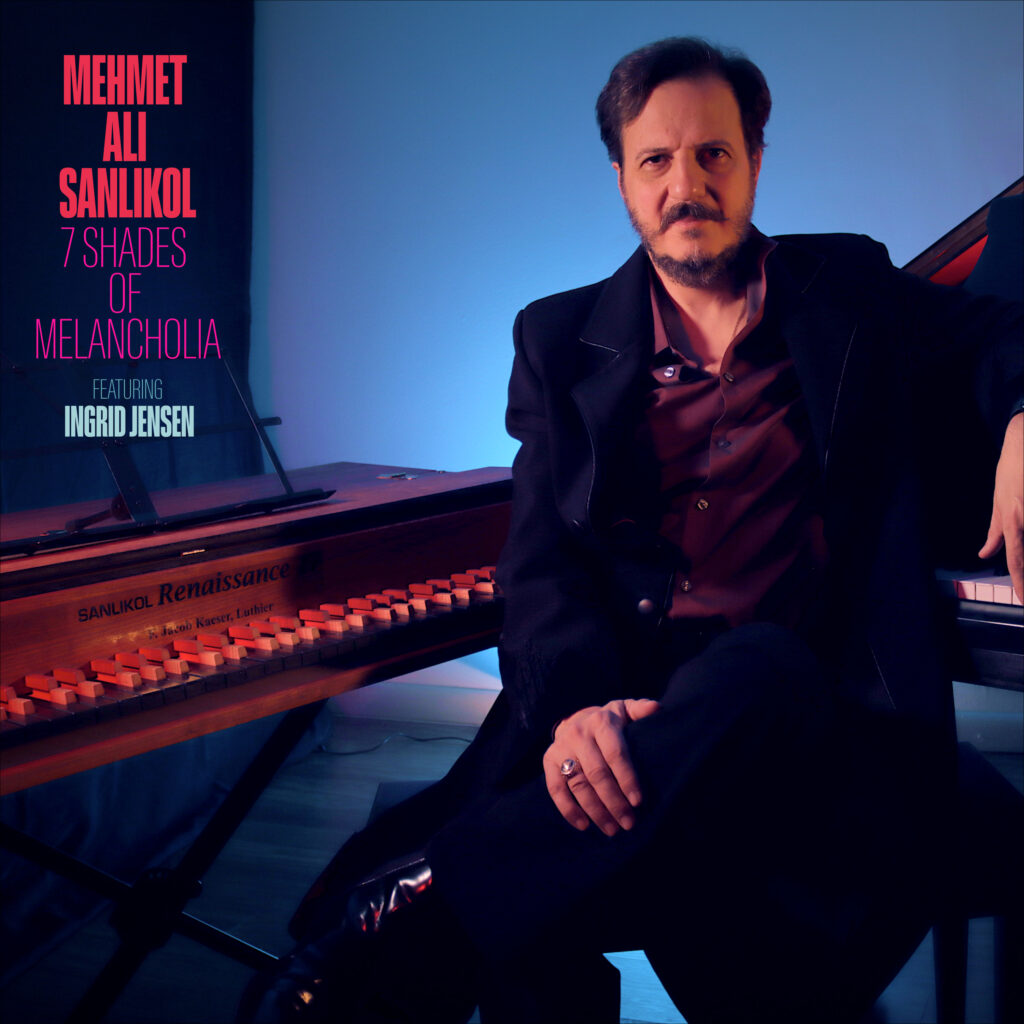
Since the music on this album displays varying degrees of Turkish musical characteristics within a jazz context, the seven pieces collectively present different shades of the ‘Turkish melancholia’ I mentioned. For instance, the opening track, originally “Annemize Türkü” (lit. a folk song for our mothers) by Muammer Sun, is a well-known children’s song in Turkey that inexplicably always makes me emotional, ever since I learned it 45 or so years ago… Although I’ve wanted to record this tune for at least a decade, I could never settle on an arrangement that felt right until one day I realized that a simple (almost a naïve) approach—similar to what John Coltrane did with “My Favorite Things”—was the perfect way to go about it. As a result, not only did Trane’s “My Favorite Things” become the model for A Children’s Song, but its influence can also be felt on the cover art of this album.
Similar to A Children’s Song, One Melancholic Montuno and My Blues don’t necessarily present compositions with intricate adaptations of Turkish musical characteristics. I wrote My Blues in 1995, only two years after arriving in the US, at which point I had no knowledge of traditional Turkish musics. However, when I look back at that tune today, I recognize a few musical characteristics that successfully evoke certain aspects of Turkish makam. On the other hand, I wrote One Melancholic Montuno just about a week before our recording session with the wonderful Ingrid Jensen. While I carefully designed this composition, the way I incorporated makam into the melody and the overall harmonic structure was quite subtle. The kind of makam I chose for this piece is similar to the one in Buselik both of which are close to the current tuning and intonation standards of Western music. When selecting the pieces to record, I somehow didn’t notice that four tracks on the album are named after makams, such as Buselik which comes from the Persian word buse (lit. kiss). In the end, I can safely say that Buselik is the most carefully designed compositional statement on this album. It begins with a single, quiet note performed by one person and gradually evolves—through strict counterpoint and controlled improvisation—into a raucous collective improvisation.
While Nikriz Semai is also named after a makam, compared to Buselik, it is a song with a simple form. It was originally written for an extended orchestral piece inspired by the Turkish shadow play Karagöz. While Karagöz is the name of the lead character, the play almost always starts with his friend Hacivat’s prologue, which is full of themes related to Sufism (Islamic mysticism). In Nikriz Semai, I took this prologue and maintained its traditional 6/8 semai usul (rhythmic cycle) while introducing a number of jazz characteristics, such as a subtle sense of swing and an overall harmonic scheme based on the nikriz makam.
Perhaps one of the most important aspects of this album for me is the introduction of the SANLIKOL Renaissance 17 (R17), a digital microtonal keyboard I conceived and designed (patent pending). In Şedd-i Araban Şarkı and Hüseyni Jam I used the R17 in order to honor the rich microtonal flavors of classical Ottoman/Turkish makam precisely which allowed me to experience and present a unique harmonic world I had never accessed before. Şedd-i Araban Şarkı, being a ballad, allows for these unique harmonic textures to fully come through within the form of a classical Ottoman şarkı. And during my vocal improvisation I tried to honor the precision of the Turkish tradition’s hyper-microtonal characteristics of by singing in unison with the R17 while transitioning in and out of scat. On the other hand, the text of this piece comes from a 17th century Ottoman source as a result of which the overall aesthetic is a unique blend of refined Ottoman poetry and music with several jazz characteristics. Whereas, Hüseyni Jam is a simple adaptation of an anonymous Turkish folk song I first encountered as a Bektashi Sufi song. The way I approached this adaptation is not much different from a jazz trio playing a folk song like “Dark Eyes” which truly becomes a vehicle for improvisation. Indeed, here too I’ve used this short but catchy melody to explore the rich microtonal capabilities of the R17 within the context of the Hüseyni makamand jazz improvisation.
Mehmet Ali Sanlıkol
All music composed by Mehmet Ali Sanlıkol (Mehteran publishing, ASCAP) except “A Children’s Song” composed by Muammer Sun (original title of the piece is “Annemize Türkü” – publisher: Median Müzik Edisyon) and arranged by Mehmet Ali Sanlıkol, and “Hüseyni Jam” which is an anonymous Turkish folk song arranged by Mehmet Ali Sanlıkol.
- Mehmet Ali Sanlıkol, piano, Renaissance 17, voice
- James Heazlewood-Dale, acoustic bass
- George Lernis, drums, gongs
- Ingrid Jensen, trumpet
- Lihi Haruvi-Means, saxophones
Produced by Mehmet Ali Sanlıkol
This album was recorded at Futura Productions (Roslindale, MA) in April and July of 2024.
Recorded by John Weston. Edited by Mehmet Ali Sanlıkol. Mixed and Mastered by John Weston at Futura Productions.